.jpg)

Q&A
The Goat Graze
Inside the surprising and delightful appearance of goats in Mountain Lakes' pocket parks.
by Ranjan O. Bose
Mountain Lakes welcomed some voracious temporary new guests in August: a small herd of goats tasked with clearing out invasive and unwanted plants on Borough properties. For over five years, the Mountain Lakes Woodland’s Committee had been studying various solutions to address the severe overgrowth and debris cluttering many of Borough-owned pocket parks across the community. A two-week pilot project was initiated, employing a small herd of South African Savannah goats, supplied by the Crescent Nūr Ranch, located in Tewksbury, New Jersey.
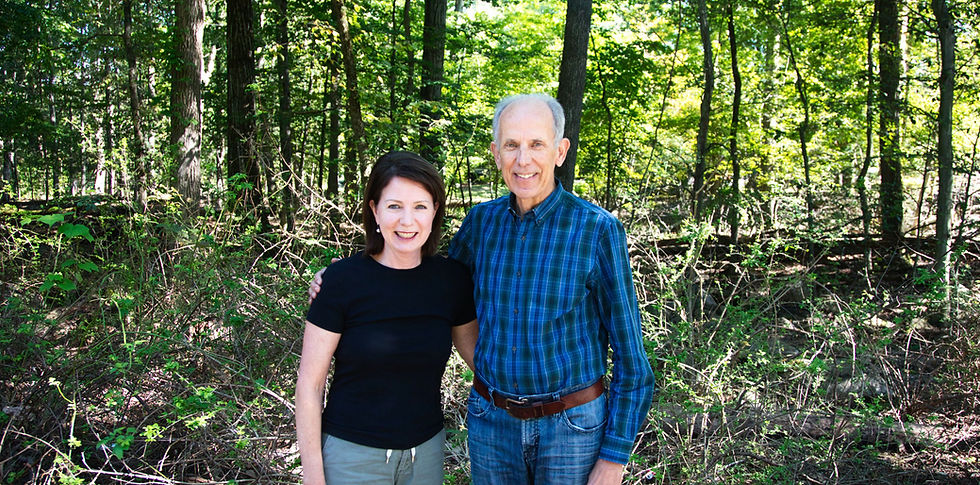
The idea was first proposed by Mountain Lakes Woodlands Advisory Committee Co-Chair Karen Macleod, a Laker since 1998, whose three children have gone through the Mountain Lakes school system. Originally from Kensington, California, a small town similar to Mountain Lakes near the San Francisco area, Karen has also been very involved with volunteer work in town and in the State as Vice President of the Mountain Lakes Garden Club, Member of the Board and Chair of the Finance Committee of the Lakeland Hills YMCA, and Treasurer of the New Jersey Garden Club.
Who first thought of bringing the goats into town as an unconventional landscaping crew?
I came up with the idea a couple of years ago. We had been working for a long time to find a solution as to the best way to restore the pocket parks in Mountain Lakes and remove debris, invasive plant life, and severe overgrowth. Large equipment and manual human labor were not feasible options due to cost, difficult access, and lack of available labor. I was out visiting a friend in somewhat rural California and noticed herds of goats being used to clear property. We began to research in the Northeast to find vendors, of which there were few. Bob Dewing (Woodlands Advisory Committee Co-Chair) finally discovered Crescent Nūr Ranch, which enabled us to launch the pilot project we just completed. Crescent Nūr Ranch has been providing grazing goat service to municipalities and other clients in New Jersey, New York, and Pennsylvania.
Our research indicated several benefits of goat grazing, including brush and invasive removal, habitat restoration, improvement of plant communities, and restoring biodiversity. The goats’ digestive systems kill the invasive seeds, so they are not refreshed in the process. This option causes the least damage to the natural environment that we are working to protect.
How were the locations selected for the Pilot Program?
The Woodlands Advisory Committee had completed an inventory of all the pocket parks in town, and had ranked them in terms of potential for successful restoration. We met with Crescent Nūr and worked with them to select a good location for the pilot that would have high visibility and impact for the community. They gave us a proposal for a two-week pilot for the two adjoining pocket parks located at the intersection of Cobb and North Briarcliff Roads. The Committee wrote up a proposal and presented it to the Borough Council, requesting a Woodlands Advisory Committee budget allocation for 2026, which was then approved.
What were the Pilot Program’s criteria?
We limited the size area to about an acre. We selected a location that was highly visible in town, had relatively flat terrain, and a manageable amount of overgrowth and debris. We needed to have access to water for the goats, and the area had to be cleared 10 feet around the perimeter in order to install the fencing.
How many goats were in the crew, and what was the cost to the Borough?
There were 16 goats in the herd, and the cost to the Borough was $5,865. We ended up being able to add a third pocket park to the pilot project, located on the Boulevard between Glen Road and Briarcliff Road, midway through the planned pilot time frame, as the goats completed grazing the first plot faster than expected.
Was the program deemed a success, and will the goats be returning?
The Pilot was only recently completed, so the Committee needs to do a formal assessment for the Borough and propose future steps. Our initial conclusion, however, was that the pilot was an enormous success! The goats achieved an amazing amount in the two weeks, and the before-and-after view of the pocket park shows exceptional improvement. The response from the community was also overwhelmingly positive. People loved the concept of a “natural” and environmentally friendly approach. They seemed to truly adore the goats and loved having them in the community. We received constant input and feedback from people walking by or intentionally visiting the goats. There seemed to be great interest in and willingness to contribute time and money to support Goat Grazing as an ongoing effort in the community.
Committee Co-Chair Dewing says: “A goal of the Committee is to encourage and set an example for the Community to take on stewardship of the pocket parks, and remove unwanted vegetation and not deposit unwanted trash/rubbish in these community spaces. Trash and litter can often be camouflaged by the invasive growth”.
There are over 100 pocket parks in Mountain Lakes, and many are worth renovating. Preliminarily, we envision the Borough establishing an annual contract to have the goats return each year to clear a selected number of Pocket Parks. The goat grazing would be supplemented by additional assistance from the Borough and the community.
Like this article? Share it with your friends!