.jpg)

Q&A
Reel Time
Big fish, small hands: Lakers tackle the annual trout derby.
by Ellen S. Wilkowe
When Ron Gironda moved to Mountain Lakes, his then neighbor George Lilieholm extended a warm welcome, but there was a catch. “He told me I was going to be co-chair of the trout derby committee,” Gironda says.
That was 52 years ago, and Lilieholm has since passed. Gironda still holds the esteemed title of longest-serving committee member and bears witness to a timeless tradition that brings the community together and offers a glimpse of Americana.
“The first trout derby in 1962 was to encourage interest in fishing and sportsmanship by the youth in Mountain Lakes,” Gironda says.
An all-hands-on-deck operation, the derby is made possible through the efforts of the recreation department, the Police Benevolent Association (PBA) Local 310, and the dozen or so members of the Trout Derby Committee. The competition is funded through recreation department funds, community-group donations, entry fees, and proceeds from merchandise sales during the event.
“The PBA has been very generous with providing most of the prizes,” Gironda says.
In advance of this year’s derby, we sat down with Gironda for a fishing expedition of our own. The contest takes place April 18 from 8 to 10 a.m. at Birchwood Lake. The cost of entry is $15 per child or $25 per family. The derby takes place rain or shine and is open to children ages 16 and under.
You’ve been involved in the derby since almost the beginning. Does the adage “the more things change, the more they stay the same” hold true?
Well, the derby actually got its start by members of the Mountain Lakes Rod and Gun Club, which is no longer, and the first few competitions up until 1965 were held on Cove Lake on Crane Road. Due to the increasing turnout, the derby outgrew its location and moved over to Birchwood Lake.
To what do you attribute the derby’s staying power?
Everyone has a job to do, and it’s a commitment. I am so proud of all the committee members who make this happen each year. The set up is very involved, and there’s a lot of off-site prep work, such as purchasing prizes, refreshments, and supplies to sell. There’s even a method to determine the number, size, and type of trout to order, and a raffle to give away unused prizes.
Did your kids grow up with a rod and reel?
My son won second place the first year we introduced the Spinner Award. The prize is named for the late Chief Spinozzi, who was affectionately known as Spinner.
What is the typical number of participants, and how has that changed over the years?
We normally get around 200, but it used to be a lot more—up to around 400 at one point. There’s a lot of competition now with spring sporting events, so we make it just two hours in the morning. That way, parents can get their kids to other activities, like the Little League parade. That wasn’t around when the derby first started.
Can you (excuse the pun) school me on the local fish? Are there existing species in the lakes that don’t require stocking from a hatchery?
As far as I know, there are sunnies and pickerels. At one point, I believe that those species were tagged.
Take me through the stocking process.
That’s a whole separate event. The Friday before the derby, the truck full of fish arrives, and we invite the community to come out and help stock the lake. The committee members stand on the truck holding buckets, while the workers from the hatchery net the fish out of the truck’s tank and drop them in the buckets. We then hand the buckets to the children, who run them across the sand and dump the fish into the lake. This year, the stocking event is April 17, from 4 to 5 p.m. at Birchwood Lake.
Are there many waders or boaters?
There are a few boaters, but most contestants fish from along the banks or docks. In its heyday, the crowd was shoulder-to-shoulder.
Let’s talk prizes.
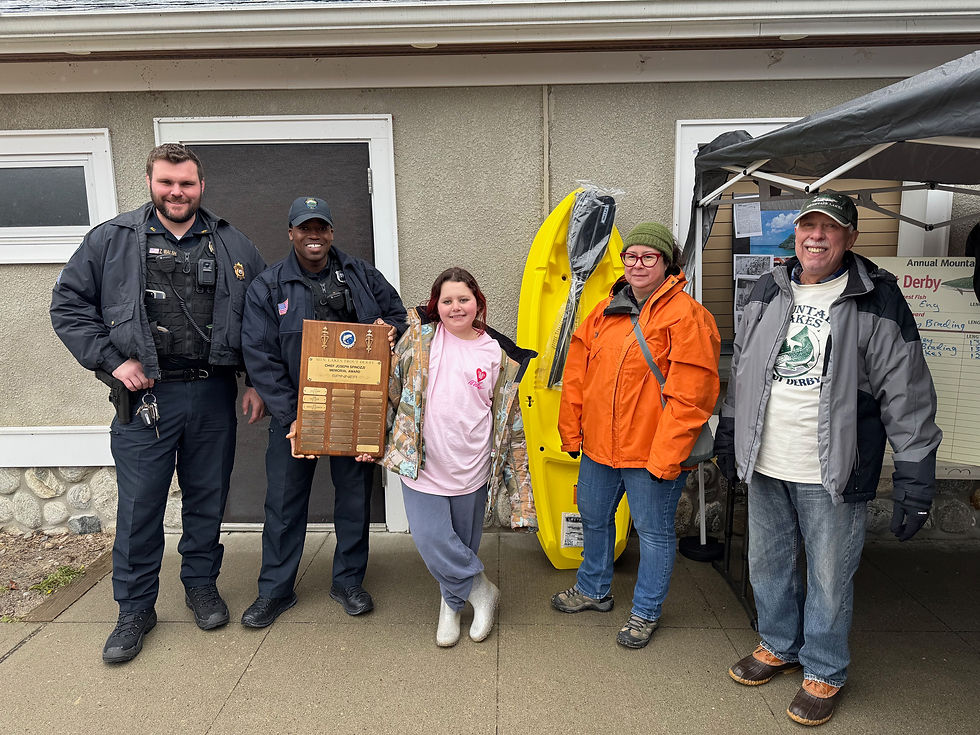
The first prize is given out by the mayor, and the winner gets his or her name engraved on the trophy. After the derby, the trophy is exhibited at the school of the winner. The second prize winner—The Spinner Award—gets his or her name engraved on a plaque. There’s also a table full of prizes to select from. The big one is usually a kayak. The first and second place winners pick first, and then the rest of the children who caught fish can select a prize based on the size of their catch, from longest to shortest. If there are any prizes remaining, there’s a raffle to hand out the rest.
What is your hope for the future?
My hope is that we continue to get new volunteers on the committee, especially as current members retire or move. The borough council and the recreation department have been very supportive of this family-oriented event and want to keep it going. I, for one, am confident that the derby will remain one of the most anticipated events in town. I can’t say enough how much I’ve enjoyed working on the committee.
Like this article? Share it with your friends!